Introduction
olimex-shield
Record EEG, ECG or EMG with an Arduino UNO and an Olimex SHIELD-EKG-EMG, a single-channel amplifier that costs about C$75 with the Arduino. This repo holds the sketch that runs on the board, a small bridge that reads it over USB and checks whether the signal can be trusted, and a browser workbench to watch, record, tag, play back and export to EEG-BIDS.
It was built for the Polarize.Tech post Can a $70 board tell me I'm wrong?, which characterises the rig in numbers.
This is not a medical device. It is a hobby amplifier, and nothing it shows is a diagnosis. Read Safety before you put an electrode on anyone.
The rig
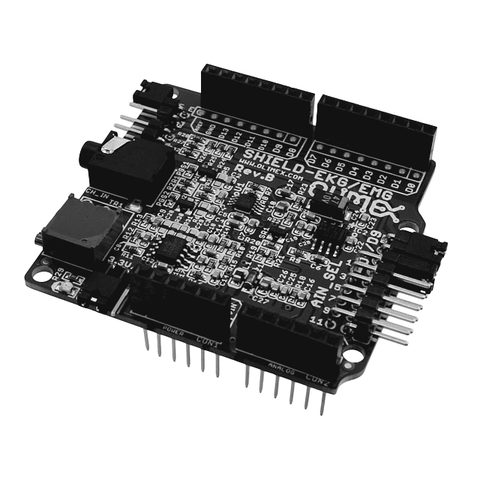
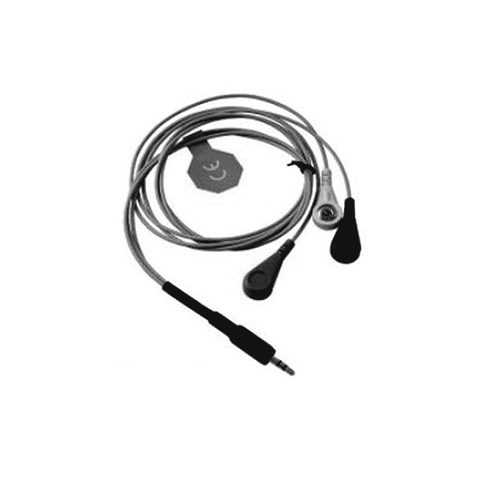
The Olimex SHIELD-EKG-EMG and its SHIELD-EKG-EMG-PRO electrode cable. Photos: DigiKey, as used in the blog post.
| Part | Role |
|---|---|
| Olimex SHIELD-EKG-EMG | Analog front end, 0.16–40 Hz, one differential channel |
| Olimex SHIELD-EKG-EMG-PRO cable | 3.5 mm jack to three snap leads |
| Arduino UNO R3 | 10-bit converter and USB serial |
| Snap electrodes | Disposable gel electrodes are best. The post used self-adhesive TENS pads, which are made for stimulation, not recording. Never ultrasound gel. |
Wiring and flashing: apps/olimex-shield/README.md.
Quick start
You need Python 3.10+ and, for the hardware, pyserial.
git clone https://github.com/polarizetech/olimex-shield && cd olimex-shield
python3 -m pip install pyserial
python3 apps/web/serve.py
Open <http://127.0.0.1:8150/>. No board yet? Pick demo://synthetic. Synthetic data is badged as synthetic everywhere it goes, including recordings and exports.
What it can and cannot see
| Band | 0.16–40 Hz, set in hardware before the converter. Software cannot recover anything outside it. |
| Sample rate | 250 Hz declared. The bridge measures the real rate, which runs slightly slow and drifts. |
| Resolution | 10-bit. The µV scale comes from the shield's built-in cal signal at its nominal amplitude and has not been checked externally (see hardware notes). |
| Intended for | Resting alpha, ECG rhythm, muscle on/off. None of these is validated against a reference amplifier yet. |
| Not for | Brainstem responses (they sit far above 40 Hz), skin conductance, or anything clinical. |
Documentation
- Hardware notes: what was measured on this board, and what is still open
- Recording, playback, uploads and BIDS export
- Standards and roadmap
- Versioning and preregistration: how changes to the measuring chain are versioned, and how claims about the rig are predicted before they are tested
- Experimental features: analysis that is not established practice
- Bridge internals
Safety
The workbench shows this list in full before every connection. Here it is too:
- This is NOT a medical device and nothing it shows is a diagnosis. If you are worried about your heart, your brain or your skin, this app is not the instrument to use.
- Run the board from a BATTERY-POWERED laptop, unplugged from mains. A mains-powered USB host puts your body between a wall socket and an electrode; the Olimex shield is not a medically isolated front end.
- Unplug EVERY mains-connected device from the laptop, not only the charger: an external monitor or HDMI cable, a powered USB hub or dock, an Ethernet cable, and any mains-powered audio interface or headphone amplifier used for stimuli. Each one is a path from mains, through the laptop, to the electrodes.
- If you cannot run on battery, a "properly isolated" power supply alone is NOT enough: isolate the USB data line too, with a USB isolator rated for patient connection (medical isolation, e.g. to IEC 60601-1). A general-purpose USB isolator is not a substitute.
- Never connect an electrode to anyone with an implanted pacemaker, ICD, or any other active implanted device.
- Never give current a path across the chest. While anything mains-referenced is connected, do not place electrodes on both arms or on both sides of the chest -- an arm-to-arm or side-to-side pair puts the heart in that path. That includes this app's own ECG limb leads: record them on battery only, with nothing else plugged in.
- Do not touch grounded metal -- a radiator, a tap, a desktop PC's case -- while you are wired up. It gives any fault current a return path through you.
- Do not place electrodes on broken skin, on a rash, or over a wound.
- Stop immediately if the skin stings, burns, itches or reddens under an electrode.
- This app applies no current and delivers no stimulation of any kind. It only listens. If any part of the rig ever produces a sensation, disconnect it.
- One person, one rig, one session. Do not connect two people to the same amplifier.
Tests
python3 scripts/check.pyStatus, citing and license
Released as-is for people who want to build the same rig; it is not yet packaged as a community open-source project. Versions are tagged, so download the latest release.
Cite with CITATION.cff. MIT licensed, see LICENSE. Vendored third-party files keep their own licences: the fonts in apps/web/vendor/design/fonts/ are SIL OFL (licence text beside each font), and the icons are a subset of Phosphor Icons (MIT, © Phosphor Icons).
Rendered from README.md.